-> Settings Electronics
The electronic configuration of the atom of an element corresponds to the location of the electron orbitals of different energy levels . Although Scrödinger model is accurate only for the hydrogen atom to other atoms applies the same model with very good approximations.
The way to show how electrons are distributed in an atom, is through the electronic configuration.
The order in which they fill the energy levels is: 1s, 2s, 2p, 3s, 3p, 4s, 3d, 4p.
The pattern of filling of atomic orbitals, we can be using the diagonal rule, for that you must carefully follow the arrow on the scheme starting in 1s, following the arrow may be added to the orbital electrons in the right way .
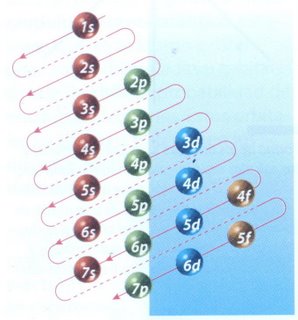
To write the electron configuration of an atom is necessary: \u200b\u200b
- Knowing the number of electrons that the atom has ; enough to know the atomic number (Z) atom in the periodic table. Remember that the number of electrons in a neutral atom equals the atomic number (Z = p +). Locate
- electrons in each of energy levels, starting from the level closest to the nucleus (n = 1). Respect
- maximum capacity of each sublevel (s = 2e-, p = 6e-, d = f = 10e-14e-).
Example:
orbitals are filled in order of increasing energy, with no more than two electrons per orbital, according to the Aufbau principle building.
Lithium (Z = 3). This element has 3 electrons. We'll start filling the lowest energy orbital with two electrons have different spin (ms). The electron Left occupy the 2s orbital, which is next with less energy:
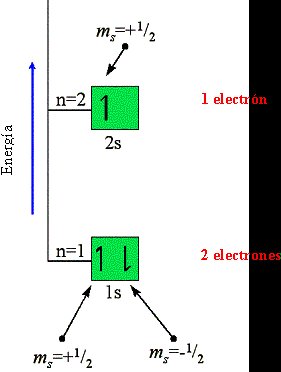
The arrow indicates the value of the fourth quantum number, the spin-to +1 / 2 - and - 1 / 2, respectively. 
can also describe the distribution of electrons in the lithium atom as 
electrons with opposite spin numbers cancel the magnetic effects are said paired electrons. An example are the two electrons occupy the 1s orbital in the atom of lithium. Similarly we say that the electron occupies the 2s orbital is unpaired. Table
then see how they are distributed electrons of the atoms in order increasing atomic number (Z):
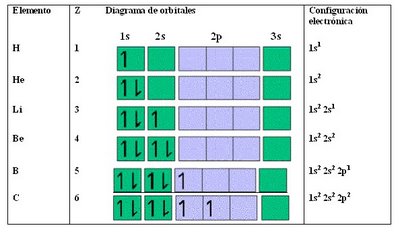
helium in completing the first level (n = 1), which makes the setup very estable.Para I Boron the fifth electron is in a 2p orbital and three 2p orbitals have the same energy no matter which one occupies.
carbon in the sixth electron could occupy the fifth orbital mime or a different one. The answer is given: Hund's rule: the more stable distribution of electrons in the sublevels is one that has the greatest number of parallel spins.
Electrons repel each other and to occupy different orbitals can be rather far apart. So the carbon in their minimum energy state has two unpaired electrons, and nitrogen has 3. 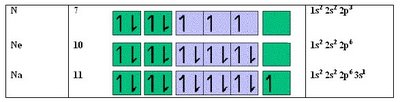
complete Neon and level two as helium has a configuration estable.Las electronic configurations can also be written in a short referring to the last full level. For this, we take the configuration noble gases because they are all complete with their orbital electrons (s2p6), for example in the case of helium (s2) and neon (s2p6) as shown in the table above.
- So the configuration of sodium Na, we can write as [Ne] 3s1
- can also write the configuration of lithium as [He] 2s1
For the electrons belonging to a level Incomplete are called valence electrons . The noble gas argon is the end of the period initiated by sodium n = 3
1s 2s 2p 3s 3p Ar

18 [Ne] 3s2 3p6
In next element, potassium with 19 electrons, we should start filling the 3d orbitals. However, the chemical behavior of potassium is similar to lithium and sodium, both with an unpaired valence electron in an s orbital, so that the potassium would correspond to the configuration [Ar] 4s1. Therefore, the 4s orbital must have lower energy than the 3d orbitals (the shielding of the electrons in the 3d orbitals is greater than that of the electrons in the 4s orbital). 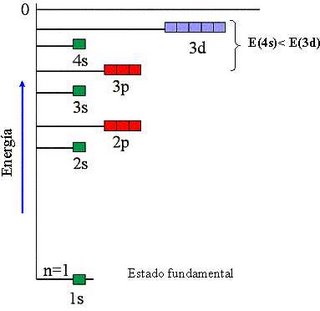
same element occurs from Sc (Z = 21) [Ar] 3d1 4s2. The last electron is added to the 4p sublevel, but the 3d, as indicated by the energy order. The same applies to the settings the emenetos Ti (Z = 22) and V (Z = 23). With chromium (Cr Z = 24) another apparent anomaly arises because its configuration is [Ar] 4s1 3D5. The logic would have been filled [Ar] 3d4 4s2, however the distribution is the first fundamental right. This is because the half empty d orbital is more stable, since their energy is lower. 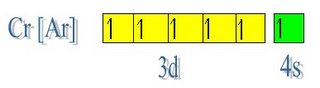
With copper Cu Z = 29 the situation is similar to chromium, pusto its fundamental configuration is [Ar] 3d10 4s1. The configuration [Ar] 3d9 4s2 is of higher energy. The configuration with 10 electrons in d orbitals, ie, the total filling of these orbitals is more stable. 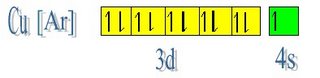
http://iiquimica.blogspot.com/2006/03/configuracin-electrnica.html
-> LINK CHEMICAL
A chemical bond is the bond between two or more atoms to form an entity of higher order, as a molecule or a crystalline structure. To form a bond two rules must be followed rule duet and octet rule.
Links Types:
Ionic bond: is the union that occurs between two atoms of different electronegativity, with a difference equal to or greater than 1.67, in this type of bond transfer occurs one or more electrons of the atom less electronegative to the more electronegative. Thus the atom that gave up electrons is positively charged and I grasp is negatively charged electrons.
The ionic bond usually occurs between the atoms of the groups:
IA - VII A
II A - VI A
III A - VA
covalent bond :
is formed between atoms of elements with similar nature, so as not to lose or gain electrons if the shares. 2 reactions between metal atoms produce no links covalentes.Este type of binding when there is a polar electronegativity.
single covalent bond
is when you share a pair of electrons between atoms that make up the link, in other words, each atom contributes one electron.
covalent bond simple: When an atom shares with another a pair of electrons with each other . (Alkanes)
double covalent bond: When an atom shared with another 4 electrons of each atom 2 (alkenes) triple covalent bond
: when an atom shares with another 6 electrons of each atom 3. (alkyne)
Hydrogen Link: when an atom hydrogen is between two electronegative atoms, establishing a link between them. The hydrogen atom has a partial positive charge, so it attracts the electron density near an atom in space.

citation
http://es.wikipedia.org/wiki/Enlace_qu% C3% ADmica
-> Periodic Table
The periodic table element is the management that, based on different criteria, different chemical elements distributed according to certain characteristics.
| Group | 1 | 2 | 3 | 4 | 5 | 6 | 7 | 8 | 9 | 10 | 11 | 12 | 13 | 14 | 15 | 16 | 17 | 18 | |
| I | II | III | IV | V | VI | VII | VIII | ||||||||||||
| Periodo | |||||||||||||||||||
| 1 | 1 H | 2 He | |||||||||||||||||
| 2 | 3 To | 4 Be | 5 B | 6 C | 7 | N O 8 9 | | F 10 Ne | |||||||||||
| 3 | 11 | Na 12 Mg | 13 Al | 14 Si | 15 P | 16 S | 17 Cl | 18 Ar | |||||||||||
| 4 | 19 K | 20 Ca | 21 Sc | 22 Ti | 23 V | 24 Cr | 25 Mn | 26 Fe | 27 Co | 28 Ni | 29 Cu | 30 Zn | 31 Ga | 32 Ge | 33 As | 34 Se | 35 Br | 36 Kr | |
| 5 | 37 Rb | 38 Sr | 39 Y | 40 Zr | 41 Nb | 42 Mo | 43 Tc | 44 Ru | 45 Rh | 46 Pd | 47 Ag | 48 Cd | 49 In | 50 Sn | 51 Sb | 52 Te | 53 I | 54 Xe | |
| 6 | 55 Cs | 56 Ba | * | 71 Lu | 72 Hf | 73 Ta | 74 W | 75 Re | 76 Os | 77 Ir | 78 Pt | 79 Au | 80 Hg | 81 Tl | 82 Pb | 83 Bi | 84 Po | 85 At | 86 Rn |
| 7 | 87 Fr | 88 Ra | ** | 103 Lr | 104 Rf | 105 Db | 106 Sg | 107 Bh | 108 Hs | 109 Mt | 110 Ds | 111 Rg | 112 Uub | 113 Uut | 114 Uuq | 115 Uup | 116 Uuh | 117 Uus | 118 Uuo |
| Lantánidos | * | 57 La | 58 Ce | 59 Pr | 60 Nd | 61 Pm | 62 Sm | 63 Eu | 64 Gd | 65 Tb | 66 Dy | 67 Ho | 68 Er | 69 Tm | 70 Yb | ||
| Actínidos | ** | 89 Ac | 90 Th | 91 Pa | 92 U | 93 Np | 94 | Pu 95 Am | 96 Inches 97 | | Bk 98 Cf | 99 is | Fm 100 | 101 Md 102 | not |
| Alkali Alkaline Earth | Lanthanides Actinides | Metals transition | ||
| p block metals | Metalloids | Nonmetals Halogens | Noble Gases |
citation
http://es.wikipedia.org/wiki/Tabla_periodica


0 comments:
Post a Comment