Wednesday, October 8, 2008

What Do You Put On A Cake For Retirement

WHAT IS AN ATOM?

What is an atom?
The atom is considered the building blocks of all matter. It is the smallest particle of an element that has all the chemical properties of that element. Atoms have a nucleus, protons and neutrons surrounded by electronesLos atoms of different elements have different numbers of protons. The simplest atom is hydrogen, which is composed of an electro and a protónConforme to that observed in the database of frequently asked questions Can I see SEED ATOMS WITH MICROSCOPE?, Atoms are very small, measuring approximately 10 -10 meters, about 2,000 times smaller than can be seen through a microscope
ópticoLa website Thomas Jefferson Laboratory (in English), announced that, from October 16, 2006, scientists reported 117 different elements. Some are known for many years, while others were discovered recently.

Free Post Nuptial Agreement Sample


This model is strictly a model of the hydrogen atom taking as its starting point the model of Rutherford, Niels Bohr, is to incorporate the phenomena of absorption and emission of gases, and the new theory of quantization of energy developed by Max Planck and the photoelectric phenomenon observed by Albert Einstein.
"The atom is a small solar system with a central nucleus and electrons moving around the nucleus in well defined orbits." The orbits are quantized (the e-can be only in certain orbits)
Each orbit has an associated energy. The outermost is the most energy.
The electrons do not radiate energy (light) while they remain in stable orbits.
Electrons can jump from one to another orbit. If it comes from a lower energy to higher energy absorbs a quantum of energy (an amount) equal to the energy difference associated with each orbit. Switching from one higher to lower, losing energy as radiation (light).
Bohr's greatest achievement was to explain the emission spectrum of hydrogen. But only the light of this element. Provides a basis for the quantum nature of light, the photon is emitted when an electron falls from one orbit to another, with a pulse of energy radiated. Bohr could not explain the existence of stable orbits and the quantization condition. Bohr found that the angular momentum of the electron is h/2π by a method that can not justify.

Where To Buy Denman Brush 30328

model of Bohr's atomic model Rutherford's atomic model


This model was developed by physicist Ernest Rutherford from the results in what is now known as the deRutherford experiment in 1911. Represents an advance over Thomson's model because it maintains that the atom consists of a positive and a negative, however, unlike the previous, postulates that the positive part is concentrated in a nucleus, which also contains virtually all the mass of the atom, while electrons are located in a crust orbiting the nucleus in circular or elliptical orbits with an empty space between them. Despite being an obsolete model, is the most common perception atom non-scientists. Rutherford predicted the existence of the neutron year 1920 , for that reason in the previous model (Thomson), do not talk about it.
Unfortunately, the atomic model of Rutherford had several inconsistencies:
contradicted the laws of electromagnetisimo
of James Clerk Maxwell, which were well proven by experimental data. According to the laws of Maxwell, a moving electrical charge (in this case the electron) should emit energy as radiation constantly and come a time in which the electron would fall on the core and the material would be destroyed. Happen all too briefly.
Not explain atomic spectra.

Tuesday, October 7, 2008

Ok To Get Wax Wiht Hemorrhoids

THOMSON ATOM


Following the discovery of the electron in 1897 by Joseph John Thomson , it was determined that the material consisted of two parts, one negative and a positive. The downside was made up of electrons, which according to this model were immersed in a mass of positive charge by way of raisins in a cake (from the analogy of English plum-pudding model).


Details of the atomic model
To explain the formation of ions, both positive and negative, and the presence of electrons within the atomic structure, Thomson devised an atom like a fruitcake. A cloud containing small positive negative particles (electrons) suspended in it. The number of negative charges was inadequate to neutralize the positive charge. In the event that the atom loses an electron, the structure would be positive, and if he won, the final charge would be negative. Thus, explaining the formation of ions, but left without explanation the existence of the other radiations.

How Do I Get My Ky Orange Safety Card

negative charge (neutron) POSITIVE CHARGE ATOM

is a subatomic particle with positive elementary electric charge (+) which is part of the nucleus of the atom.

The proton has a positive charge and a mass 1,840 times that of the electron (which, by convention, is equal to 1). In a stable atom, the number of protons in the nucleus is equal to that of electrons. The proton and the neutron are also called nucleones.El hydrogen atom's nucleus is composed of a single proton. The mass of a proton is 1.6726 × 10⁻²⁷ kg, approximately 1,836 times that of the electron. Therefore, the mass of an atom is concentrated almost exclusively on his núcleo.El proton has an intrinsic angular momentum or spin, and therefore a magnetic moment.

Moreover, the proton satisfies the exclusion principle. The atomic number of an item indicates the number of protons in its nucleus, and determines what element it is.

Mixed Wrestling Sessions

(PROTON)

In chemistry, the proton (in Greek proton means first) is a subatomic particle an electric charge elementary positive (1.602 × 10 -19 coulombs) and a mass of 938.3 MeV / c 2 (1.6726 × 10⁻²⁷ kg) or, similarly, about 1836 times the mass of an electron . Experimentally, the proton is observed as stable, with a lower limit on its half-life about 1035 years, although some theories predict that the proton can decay, ie the particles lose their posse and consistency as such the atom. The proton and the neutron , together known as nucleons , and which constitute the nucleus of atoms.

Install Halo On Impala

atomic models (Jhon Dalton atomic model)

DALTON MODEL:


EXPLANATION:

was the first science-based atomic model was formulated in 1808 by John Dalton was the first atomic model of:

  • The particulate matter was made very Small called atoms, which are not visible and are nondestructive

  • atoms of one element are equal to each other, have their own weight and qualities. Atoms of different elements have different weights.

  • remain split atoms, even when combined in chemical reactions.

  • Atoms combine to form compounds to keep relationships simple.

  • Atoms of different elements can be combined in different proportions and form more than one compound.

  • chemical compounds are formed by joining two or more atoms of different elements.

but disappeared by the Thomson model because they fail rays cadódicos, radioactivity and the presence of electrons (e-) and protons (p +)

Wednesday, October 1, 2008

Is It Normal For Toincilis To Stay Swollen

1. Bond-breaking mechanisms (continued)

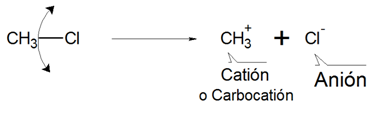
1.2. Heterolytic rupture: occurs when the bonding electrons are held by one of two chemical species. As a result, one that retained the electrons have a net negative charge (anion call) while the other, the lack thereof, have a net positive charge (called a cation ).


heterolytic breaking Example 'carbocation. " Image taken from blog
cienciaslasalleenv.blogspot.com.
This image was made using the program ACD / ChemSketch 10.0

The organic species resulting CH3 +, has only six electrons aparadeados, and thus acquires a positive charge on the carbon atom, called ion carbonium or carbocation.
ions are carbocations containing positively charged carbon atom with six electrons in three links. Carbonium ions are usually represented as R +.
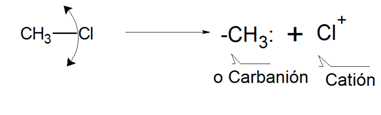
Secondly it is possible that the two bonding electrons leave the substituent group (Cl) and are held by an organic group (CH3), resulting in an organic species with 8 electrons, so the carbon atom acquires a charge negative and is called carbanion or R-


example heterolytic breaking 'carbanion'.
cienciaslasalleenv.blogspot.com Image taken from the blog.
This image was made using the program ACD / ChemSketch 10.0
The carbanions are negatively charged ions containing a carbon atom with three links and a shared pair of electrons. The species resulting from a heterolytic rupture are highly reactive, reacting quickly with other molecules. In general, such species are intermediates in reactions and are characterized by very short-lived, so it is not easy detect or isolate them by ordinary physicochemical methods.

In this address you will find a simulation of a heterolytic breakdown:


http://medicina.usac.edu.gt/quimica/hidrocar/alcanos/Rompimiento_Heterol_tico.htm
To apply and reflect:
  • How important ions in the functioning of your body?
  • You know what's an electrolyte, and how they relate to the ions?

How To Install Halo On Impala

1. Bond-breaking mechanisms

If you look at any organic reaction shows that break bonds in the reactants and forming new bonds in products. The breaking of bonds can be symmetrical, also called asymmetric or homolytic and heterolytic. The first originates neutral species with unpaired electrons called free radicals and the second produces ionic species .


1.1. homolytic cleavage: in this case, each species maintains the electron initially supplied to form the link. each of species formed are called free radicals, which are very unstable particles, energy and electrically neutral. For this breakdown is necessary for the presence of ultraviolet light (hv) or heat.


example of homolytic breaking.
cienciaslasalleenv.blogspot.com Image taken from the blog.
This image was made using the program ACD / ChemSketch 10.0
find in this direction a simulation of a homolytic break:


To apply and reflect:
  • Does the presence of free radicals its effects on the formation of mutations in DNA?
  • How do ultraviolet rays on your skin?

Flor Squares In Washing Machines


Each chemical transformation involves a change in the connectivity of the atoms. Some links are broken and new ones are formed. The organic chemistry is concerned not only by the reactants and products of a reaction, but also the details, especially the order of the processes of breaking and bond formation. Also is interested in the study of reaction rates and investigate how the speed and products vary depending on the experimental conditions.
also explores the stereochemical changes that occur during the reaction. From observations like these, I postulate the details of the process or path that the reagents are for processing into products. This reaction path is called the reaction mechanism.

Importance of reactions

reactions are an important element of organic chemistry, and knowledge is essential to the chemical. The conversion of a other substances is performed by use of reactions, which often act on specific groups of the molecule.
organic reactions have two special characteristics of the inorganic differences: they develop a very low speed and, in most cases, only the functional group involved in the reaction, so the rest of the organic molecule remains intact .
in organic processes is rare that a given reagents lead to products defined by a unique reaction. Typically, the reaction we expect to be accompanied by other secondary processes, so that not only gets the products that we hope but also displayed as a result of these secondary processes. This suggests that the reaction products depend to a large extent on the experimental conditions.
To apply and reflect:
  • what bodily processes can identify an organic reaction?
  • industrial level, social and / or economic influence how the reactions in man's life?

Cybergraphy: