1.2. Heterolytic rupture: occurs when the bonding electrons are held by one of two chemical species. As a result, one that retained the electrons have a net negative charge (anion call) while the other, the lack thereof, have a net positive charge (called a cation ).
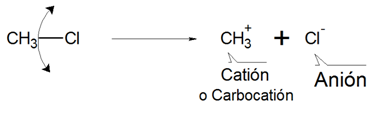
heterolytic breaking Example 'carbocation. " Image taken from blog
cienciaslasalleenv.blogspot.com.
This image was made using the program ACD / ChemSketch 10.0
cienciaslasalleenv.blogspot.com.
This image was made using the program ACD / ChemSketch 10.0
The organic species resulting CH3 +, has only six electrons aparadeados, and thus acquires a positive charge on the carbon atom, called ion carbonium or carbocation.
ions are carbocations containing positively charged carbon atom with six electrons in three links. Carbonium ions are usually represented as R +.
Secondly it is possible that the two bonding electrons leave the substituent group (Cl) and are held by an organic group (CH3), resulting in an organic species with 8 electrons, so the carbon atom acquires a charge negative and is called carbanion or R-
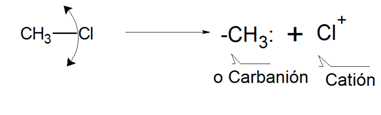
example heterolytic breaking 'carbanion'.
cienciaslasalleenv.blogspot.com Image taken from the blog.
This image was made using the program ACD / ChemSketch 10.0
The carbanions are negatively charged ions containing a carbon atom with three links and a shared pair of electrons. The species resulting from a heterolytic rupture are highly reactive, reacting quickly with other molecules. In general, such species are intermediates in reactions and are characterized by very short-lived, so it is not easy detect or isolate them by ordinary physicochemical methods.
In this address you will find a simulation of a heterolytic breakdown:
http://medicina.usac.edu.gt/quimica/hidrocar/alcanos/Rompimiento_Heterol_tico.htm
In this address you will find a simulation of a heterolytic breakdown:
http://medicina.usac.edu.gt/quimica/hidrocar/alcanos/Rompimiento_Heterol_tico.htm
To apply and reflect:
- How important ions in the functioning of your body?
- You know what's an electrolyte, and how they relate to the ions?


